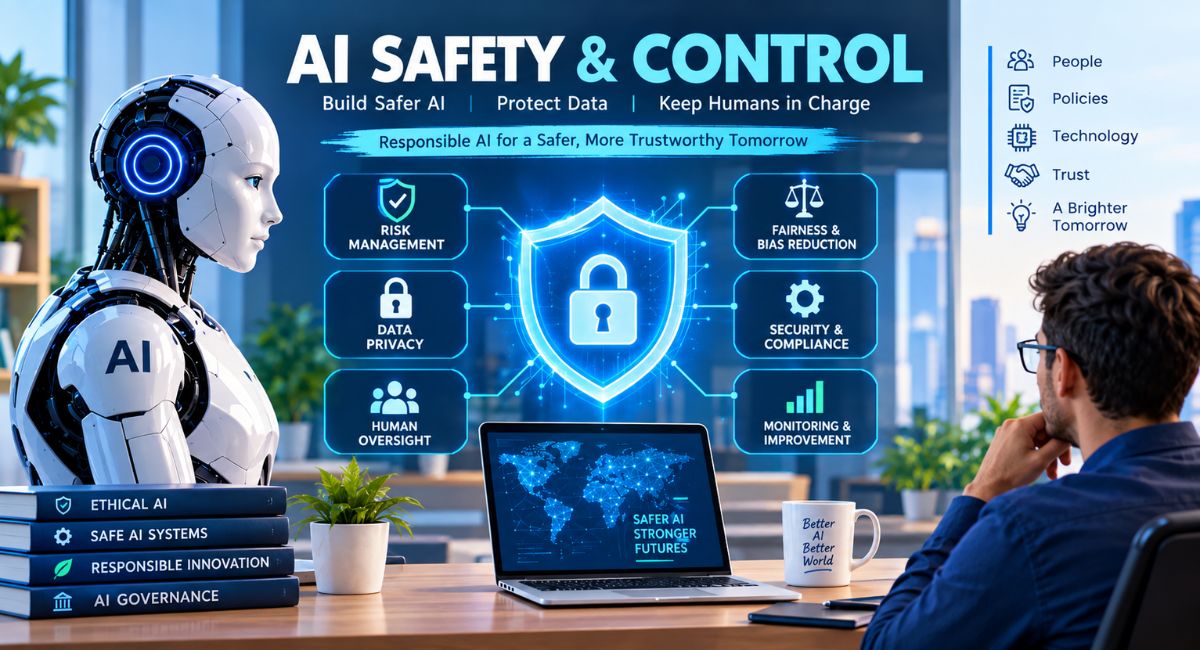
AI Safety and Control: How to Keep Artificial Intelligence Secure.
Artificial intelligence is rapidly becoming part of everyday business and technology. Companies are using AI to analyze information, automate repetitive tasks, improve customer service, detect suspicious activity, generate software code, and support important business decisions.
However, as artificial intelligence becomes more powerful and autonomous, another question becomes increasingly important: How can organizations make sure AI systems remain safe, secure, reliable, and under appropriate human supervision?
This is where AI safety and control become essential.
AI safety involves designing and operating artificial intelligence systems in ways that reduce harmful, unpredictable, or unintended outcomes. AI control focuses on keeping humans responsible for how AI systems operate, what information they can access, and which actions they are allowed to perform.
Together, these concepts form an important part of responsible AI, AI governance, AI risk management, cybersecurity, and trustworthy artificial intelligence.
What Is AI Safety and Control?
AI safety is the practice of identifying and reducing risks associated with artificial intelligence systems. It includes testing AI models, protecting sensitive information, preventing harmful behavior, detecting vulnerabilities, and ensuring that AI performs according to its intended purpose.
AI control refers to the mechanisms that allow people and organizations to maintain oversight over AI applications. This becomes especially important when an AI system can make decisions, interact with software, access databases, use online services, or operate with limited human intervention.
An effective AI safety strategy may address:
- Unpredictable or harmful AI behavior
- AI-generated misinformation and inaccurate responses
- Data privacy and information security
- Algorithmic bias and unfair decisions
- Unauthorized access to systems
- Prompt injection and other AI security threats
- Excessive permissions given to AI agents
- Lack of human review
- Autonomous AI decision-making
- Model failures and unexpected outputs
The objective is not to prevent innovation. Instead, the purpose is to make artificial intelligence safer, more transparent, controllable, and dependable.
Why Does AI Safety Matter?
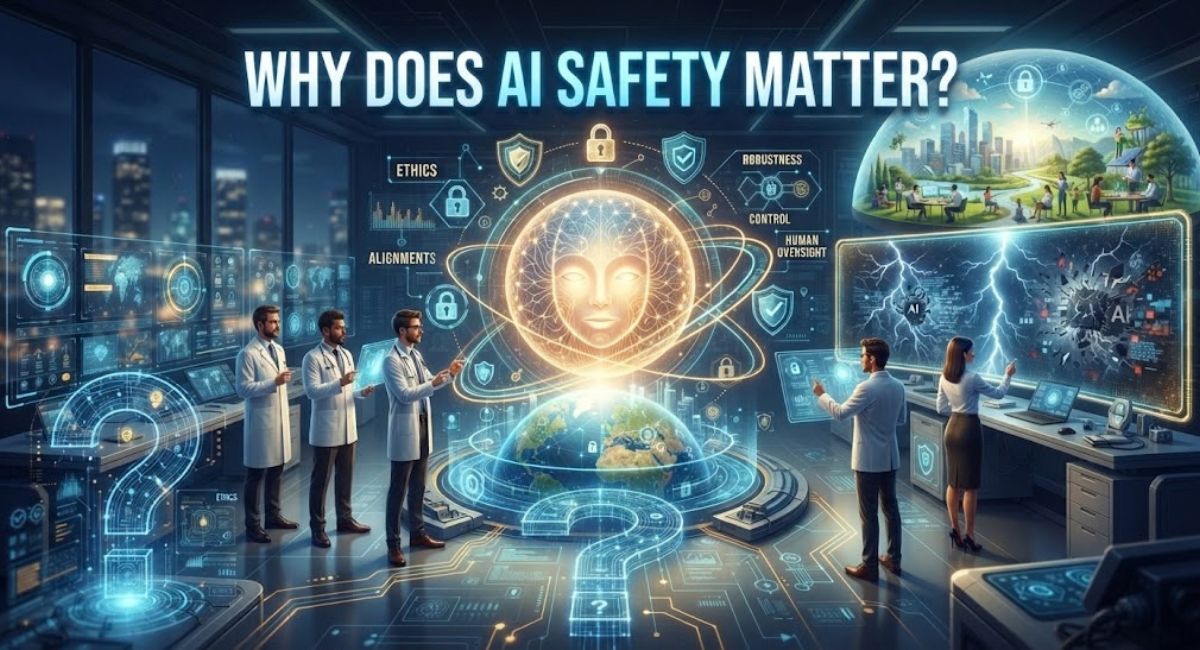
Artificial intelligence can improve productivity, but errors can also create serious consequences when AI is used in sensitive environments.
Consider an organization using an AI system to screen job applications. If the underlying data contains historical bias, the system could unintentionally favor certain candidates while disadvantaging others.
Similarly, an AI-powered financial assistant could provide an inaccurate recommendation, while an automated customer-support system could give users incorrect information if its responses are not properly monitored.
These examples demonstrate why AI risk management should begin before an artificial intelligence system is deployed.
Organizations need to understand:
- What the AI system is designed to do
- What information it can access
- What decisions it can make
- What actions it can perform
- Where human approval is required
- How failures will be detected
- How the system can be stopped if necessary
AI Safety in the Workplace
Businesses are increasingly adopting generative AI tools, AI chatbots, machine learning platforms, and autonomous AI agents.
While these technologies can improve efficiency, they can also create new operational and cybersecurity challenges.
For example, an employee could accidentally enter confidential company information into an AI application. An AI agent with excessive permissions could potentially access files or services that it does not actually need.
Businesses should therefore establish clear AI usage policies and security controls.
Important measures include:
1. Conduct AI Risk Assessments
Before introducing an AI solution, organizations should identify possible risks.
A risk assessment can examine:
- Data exposure
- Security vulnerabilities
- Incorrect AI decisions
- Bias
- Regulatory requirements
- Third-party dependencies
- Human oversight requirements
- Potential misuse
The level of protection should depend on the potential impact of the AI application.
2. Apply Access Restrictions
AI applications should not automatically receive unrestricted access to company systems.
Using the principle of least privilege, an AI system should receive only the permissions necessary to perform its assigned task.
For example, an AI customer-support assistant may need access to customer order information, but it may not need permission to modify financial records.
3. Maintain Human Oversight
Human involvement remains important when AI systems influence high-impact decisions.
Organizations can create approval workflows where AI prepares a recommendation while a qualified employee makes the final decision.
This approach is commonly described as human-in-the-loop AI.
4. Test AI Systems Regularly
AI systems should be evaluated before and after deployment.
Testing can examine:
- Accuracy
- Reliability
- Bias
- Security
- Privacy
- Unexpected responses
- Resistance to malicious inputs
- Performance under unusual conditions
Regular AI model testing helps organizations identify weaknesses before they cause significant problems.
Human-in-the-Loop AI Control

One of the most practical approaches to AI governance is human-in-the-loop control.
Under this model, AI can automate certain activities while humans remain responsible for important decisions.
For example:
AI system → analyzes information → produces recommendation → human reviews → final decision
This structure can be useful in areas such as:
- Recruitment
- Banking
- Healthcare
- Insurance
- Legal services
- Cybersecurity
- Government services
- Financial analysis
Not every AI task requires human approval. A system generating a simple internal summary may operate with minimal intervention, while an AI system making a high-impact decision may require mandatory human review.
The appropriate level of oversight should therefore depend on the risk level and potential consequences of the AI application.
AI Alignment and Reliable Behavior
Another important concept is AI alignment.
AI alignment is broadly concerned with whether an AI system behaves according to its intended goals, instructions, restrictions, and human expectations.
A system may technically follow an instruction while still producing an undesirable result. This is why organizations need more than simple prompts.
Good AI control can involve:
- Clear system instructions
- Defined objectives
- Restricted capabilities
- Safety policies
- Output validation
- Human approval
- Testing against edge cases
- Continuous performance evaluation
Reliable AI should not simply produce impressive results. It should also behave consistently within its intended boundaries.
AI Security and Cybersecurity Risks
Artificial intelligence introduces another layer to the cybersecurity landscape.
Modern AI applications can interact with databases, APIs, cloud platforms, business software, and external tools. Poorly secured integrations can create opportunities for attackers.
Common AI security concerns include:
- Prompt injection
- Sensitive data leakage
- Unauthorized access
- Insecure APIs
- Excessive permissions
- Malicious inputs
- Model manipulation
- Account compromise
- Insecure third-party integrations
Organizations should treat AI applications as part of their broader cybersecurity architecture.
Security controls such as authentication, authorization, encryption, secure API design, logging, monitoring, vulnerability assessments, and access management can help reduce these risks.
Protecting Data Used by AI
Data protection is another major part of responsible AI implementation.
AI applications may process:
- Customer information
- Employee records
- Financial information
- Business documents
- Source code
- Internal communications
- Personal information
Organizations should understand what data an AI application collects, where that information is processed, how long it is retained, and who can access it.
Strong AI data privacy practices can include:
- Data minimization
- Encryption
- Access controls
- Secure storage
- Data classification
- Retention policies
- Privacy reviews
- Employee training
Companies should avoid providing AI systems with sensitive information unless there is a legitimate business requirement and appropriate security protection.
Continuous AI Monitoring
AI safety should not end when a system goes live.
An AI model can behave differently over time because users, data, software integrations, and operating environments change.
For this reason, organizations should implement continuous AI monitoring.
Monitoring may track:
- Model accuracy
- Error rates
- Unexpected responses
- Security events
- User complaints
- Data quality
- System performance
- Changes in model behavior
- Unusual activity
Automated alerts can notify security or engineering teams when predefined thresholds are exceeded.
This creates a feedback loop:
Deploy → Monitor → Detect → Investigate → Improve → Test → Deploy again
Continuous monitoring is particularly important for AI agents that can perform actions instead of simply generating text.
AI Agents and Autonomous Systems
The growth of AI agents is making AI control even more important.
Traditional AI applications may simply answer a question or generate content. An AI agent can potentially plan tasks, call APIs, access information, execute software operations, and complete multi-step workflows.
Greater autonomy can produce greater productivity, but it also increases the importance of safeguards.
Organizations should establish clear boundaries around:
- Which tools an AI agent can use
- Which websites or services it can access
- What data it can read
- What actions it can perform
- When human approval is required
- How actions are logged
- How the agent can be stopped
A useful principle is simple:
The more power an AI system has, the stronger its controls should be.
Testing AI Against Unexpected Situations
Traditional software testing remains important, but AI systems require additional forms of evaluation because their outputs may vary.
Organizations can perform AI red teaming and adversarial testing to identify weaknesses.
Testers may deliberately provide:
- Misleading questions
- Malicious instructions
- Conflicting requirements
- Sensitive information
- Unusual inputs
- Prompt injection attempts
- Requests outside the system’s intended purpose
The goal is to understand how an AI system behaves when conditions are not ideal.
These tests can reveal weaknesses that normal functional testing might not detect.
Practical AI Safety Checklist
Organizations beginning their AI journey can use a simple checklist.
Define the AI’s Purpose
Clearly document what the system is intended to accomplish.
Establish Boundaries
Specify what the AI is allowed to do and what it must never do.
Classify the Risk
A general-purpose writing assistant and an AI used for financial decisions should not receive the same level of controls.
Limit Permissions
Give AI applications only the access they actually need.
Protect Sensitive Data
Use appropriate security and privacy controls for confidential information.
Test Before Deployment
Evaluate accuracy, reliability, security, bias, and unexpected behavior.
Monitor After Deployment
Track system performance and investigate unusual activity.
Keep Humans Responsible
Important decisions should have clearly defined human accountability.
Maintain Documentation
Record system capabilities, limitations, testing results, incidents, updates, and changes.
Prepare an Emergency Shutdown Process
Organizations should know how to disable or restrict an AI system if it begins behaving unexpectedly.
AI Governance and Responsible AI
AI safety is closely connected to AI governance.
AI governance refers to the policies, processes, responsibilities, and technical controls organizations use to manage artificial intelligence responsibly.
A mature AI governance program may define:
- Who owns an AI system
- Who can approve deployment
- How risks are classified
- What data may be used
- Which systems require human approval
- How AI performance is monitored
- How incidents are reported
- How changes are documented
Responsible AI therefore involves both technology and organizational accountability.
Technical safeguards alone cannot solve every AI-related problem. Employees, managers, developers, security teams, legal professionals, and other stakeholders may all have responsibilities depending on the system.
The Future of AI Safety and Control
Artificial intelligence is moving toward increasingly capable systems that can reason, use tools, interact with applications, and complete complex workflows.
As AI becomes more autonomous, AI governance, AI security, model evaluation, human oversight, and risk management will become increasingly important.
Future organizations may rely on multiple layers of AI protection, including automated monitoring, security testing, access restrictions, human approval systems, independent evaluations, and formal AI governance frameworks.
The important question will not only be:
“What can artificial intelligence do?”
It will also be:
“What should AI be allowed to do, under which conditions, and how can humans verify that it is operating safely?”
Conclusion
AI safety and control are becoming essential as artificial intelligence becomes more capable and widely adopted.
Businesses can gain significant advantages from AI, but those benefits should be supported by appropriate security, testing, monitoring, data protection, and human oversight.
A responsible AI strategy should combine:
- AI risk management
- Human-in-the-loop oversight
- AI security
- Data privacy
- Model testing
- Continuous monitoring
- Access control
- AI governance
- Adversarial testing
- Clear accountability
The goal is not to prevent organizations from using artificial intelligence. The goal is to create an environment where AI can be used productively, securely, responsibly, and with appropriate human control.
As AI technology continues to evolve, organizations that build safety and governance into their systems from the beginning will be better positioned to benefit from AI while reducing unnecessary risks.